


















Situation Went Out of Control: Army Chief
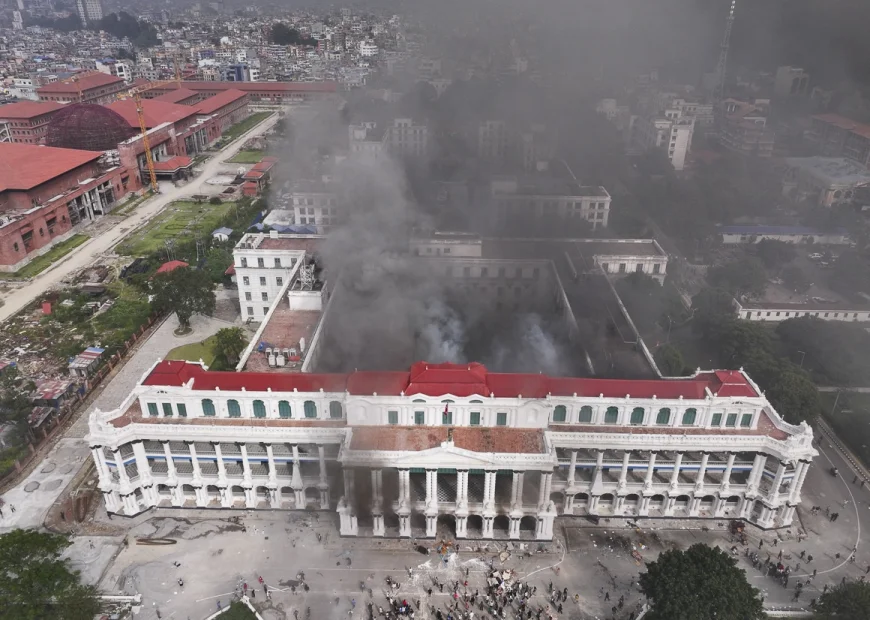


Chief of Army Staff Ashokraj Sigdel has said that the situation went out of control from early morning on Bhadra 24 following the heavy use of force the previous day.
While giving his statement to the investigation commission, Sigdel explained that public anger had sharply escalated due to the casualties the day before, leading to an uncontrollable situation from the morning hours.


“After such an incident in a short time and in such a small area, the situation was abnormal and out of control from early the next morning,” a commission-related source quoted Sigdel as saying. He added that although a curfew should have been imposed early in the morning to control the situation, the circumstances were allowed to appear normal until around 10 a.m., giving people the opportunity to come out, which further worsened the situation.
According to the source, Sigdel stated that when the situation had already deteriorated badly around 10 a.m., declaring a state of emergency or taking similar measures through a meeting of the National Security Council could have helped. However, he emphasized that the army could not be mobilized on its own without decisions from legitimate and responsible state bodies.


He also stated that in several places, soldiers repeatedly tried to protect senior officials and government institutions and even rescued many police personnel who were in difficult situations, saving their lives.
“If the army had been deployed on its own after the situation had already gone out of control, it would not have been possible to restore order without the use of force,” a source quoted Sigdel as saying. “The damage caused by the use of force would have been far more severe, which is why we exercised restraint.”
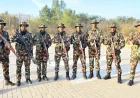
Along with Chief of Army Staff Sigdel, senior military officials, including those responsible for the security of high-ranking officials, also appeared before the commission to give statements.
The Nepali Army had earlier provided a similar response to the Supreme Court, but sources said the statement given to the commission was more detailed than the written reply submitted to the court.
In its response to the Supreme Court, the Army’s Judge Advocate General’s Department stated that repeated efforts were made to stop the crowd attempting to enter Singha Durbar. Responding on behalf of Chief of Army Staff Ashokraj Sigdel, it claimed that 46 rounds were fired into the air and that an aggressive mob that entered through the main gate twice was physically pushed back.
The statement said that when large crowds entered Singha Durbar angrily from all four directions, and it became clear that the crowd could not be stopped without significant human casualties, the Nepali Army took necessary initiatives to maintain peace and security.
Submitting a written response to the Supreme Court, Lieutenant General Jivan Prasad Dahal of the Judge Advocate General’s Department stated that the agitated crowd that entered Singha Durbar through the main gate twice was physically pushed back, persuaded, and sent out after 46 rounds of aerial firing.
Emphasizing that human security is more important than physical security, the Army claimed it exercised restraint as large crowds advanced toward Singha Durbar from all sides.
The Constitution of Nepal, under Article 266(1), provides for the National Security Council. On the council’s recommendation, the government can mobilize and control the Nepali Army. The Army has argued that the Chief of Army Staff is limited to implementing government orders and directives and cannot deploy the army at will. It has also indicated that the National Security Council could not be activated in time on Bhadra 24.
In his statement to the commission on Sunday, Chief of Army Staff Sigdel also gave a detailed explanation of the structure of the National Security Council and the role of the army within it. The council, chaired by the Prime Minister, includes the Defence Minister, Home Minister, Foreign Minister, Finance Minister, Chief Secretary, and the Chief of Army Staff as members, with the Defence Secretary serving as member-secretary.
According to commission-related sources, Sigdel maintained that he could not deploy the army on his own as he is only a member of the council, and claimed that the situation would have worsened further if the army had acted independently.
Lieutenant General Jivan Prasad Dahal also stated that from the night of Bhadra 24, national interest became the top priority for the Nepali Army in maintaining peace and security. In its response to the Supreme Court, the Army noted that following the incidents of Bhadra 23 and 24, it conducted an objective assessment and took necessary initiatives to ensure peace, security, and public safety. Military officials also told the commission that, apart from facilitating dialogue, the Nepali Army did not involve itself in political matters.
What's Your Reaction?
 Like
0
Like
0
 Dislike
0
Dislike
0
 Love
0
Love
0
 Funny
0
Funny
0
 Angry
0
Angry
0
 Sad
0
Sad
0
 Wow
0
Wow
0