


















Financial Technology Spreads as Digital Transactions Boom in Nepal
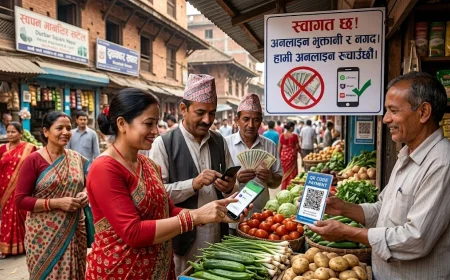
Nepal’s fintech sector has boomed dramatically post-COVID-19, with monthly QR transactions reaching an astronomical NPR 162.58 billion (1 Kharba 62 Arba 58 Crore) and mobile banking exceeding NPR 612 billion. While this transformation has empowered small, home-based businesses and prompted the central bank to introduce collateral-free digital loans and a "Digital Rupee" (CBDC), it has also triggered a dangerous spike in cyber fraud. Sophisticated scams like phishing links and fake social media profiles aggressively target users, with an alarming 50% of fraud suspects being youth aged 19–24, making individual vigilance and data security more critical than ever.

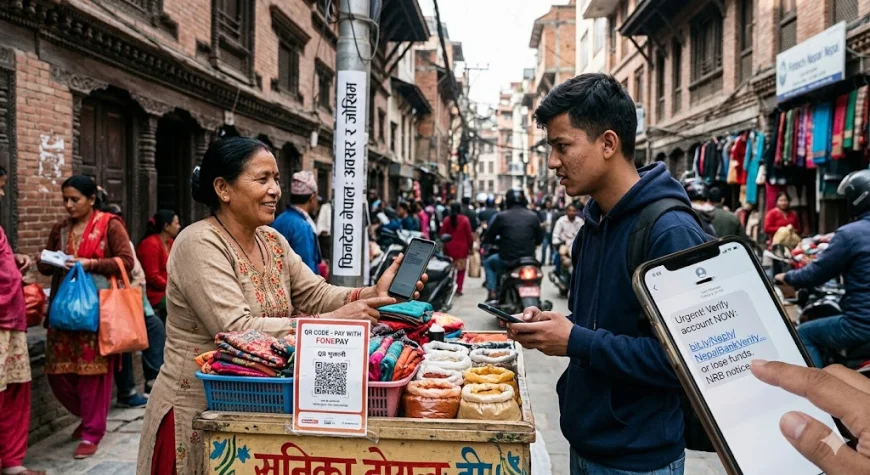


Paru Ghimire, a home-based entrepreneur running 'Paru Collection' on TikTok from Kathmandu, managed to sell 375 outfits across various cities in Nepal within just two months. Before shipping her goods, she collects payments using mobile banking and relies entirely on digital payment gateways to pay her wholesalers. For a mother managing household chores alongside a business, financial technology (Fintech) has proven to be a transformative blessing.
"If it weren't for mobile banking, I wouldn't have been able to run an online business at all," Ghimire said. "For women like us who stay home to care for children, digital payments have made it incredibly easy to manage a shop and execute transactions from the comfort of our homes." She adds that she no longer carries cash to markets, citing that compiled digital records make auditing and tracking revenue much tighter.


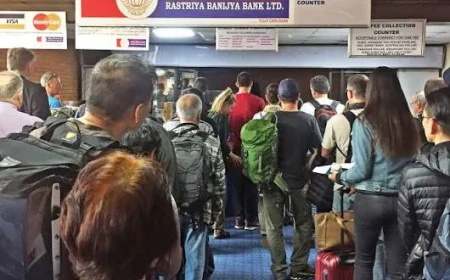
Ghimire’s story is a microcosm of Nepal's ongoing Fintech revolution. Short for financial technology, Fintech includes digital ecosystems like eSewa, Khalti, ConnectIPS, Fonepay, Prabhu Money Transfer Digital, and share trading tools like TMS. These services have eliminated the tedious lines at physical banks, making everything from opening accounts and online ticketing to Video-KYC verification instantly accessible.


The Post-COVID Cashless Surge
According to Santosh Tamrakar, Managing Director of IMS Software Pvt. Ltd., a company specializing in digital billing and accounting software. Nepal's cashless transition skyrocketed specifically after the COVID-19 pandemic. "Today, citizens routinely buy goods even with empty pockets," Tamrakar observes. "Platforms like Fonepay and NepalPay have secured capital within the country and brought complete transparency to daily transactions."
Subas Sharma, Executive Director and spokesperson of F1Soft, the company that developed Nepal’s first digital wallet and payment gateway (eSewa) in 2009, notes that the groundwork for digital payments is now firmly established. Nepal currently boasts 22 active mobile wallets. This massive wave of digital footprints has also allowed banks to venture into digital lending, offering small, collateral-free loans directly based on a user's transaction data.
"So far, we have focused on making spending easier for clients. Now, Fintech must evolve to help people earn, save, and invest," Sharma emphasizes. "Digital lending is just taking off, and startups have vast untapped horizons to explore."
Nischal Bank, Chief of the Payment Department at Nepal Rastra Bank (NRB), agrees that the surge in digital transactions is a massive positive for the national economy. "It accelerates money velocity and pulls the informal economy into the formal net," he states.
A Quantum Leap in Transaction Data
Data provided by Nepal Rastra Bank reveals staggering milestones. In a single recent month, QR code transactions were executed over 59.26 million times, circulating over NPR 162.58 billion in value. Mobile banking remains the absolute leader, accounting for a massive NPR 612.39 crore in transactions per month, while micro-wallets like eSewa and Khalti processed NPR 53.01 billion.
To put this growth into perspective, five years ago (FY 2077/78), monthly QR transactions barely scratched NPR 2.5 billion, while mobile banking hovered around NPR 48 billion. The thousands-fold multiplication highlights an exponential trajectory. "The true achievement is how banking accessibility has reached the common citizen," F1Soft’s Sharma pointed out. "This is verified by the fact that a country of 30 million people now holds 60 million active bank accounts."
Furthermore, global assessments back this success. The World Bank Group and International Finance Corporation (IFC) recently noted in their report, "Digital Financial Services in Nepal," that among the eight major pillars defined in the government's Digital Nepal Framework 2076, the Financial Pillar stands alone as a transformative success.
Expanding Borders: Digital Lending and the Digital Rupee (CBDC)
Recognizing this boom, the central bank recently revised its digital lending guidelines to include Micro, Small, and Medium Enterprises (MSMEs). Under the new mandates, small businesses can acquire short-term digital loans of up to NPR 500,000 (up to 1 year) and long-term digital loans up to NPR 1,000,000 via electronic banking streams. Previously, such loans were capped strictly for salaried individuals.
Simultaneously, the NRB is actively forging ahead with legal amendments and prototypes for the Central Bank Digital Currency (CBDC), or the "Digital Rupee." Unlike mobile wallets or banking apps that strictly require a commercial bank account, the CBDC is an electronic note issued directly by the central bank. This will allow unbanked citizens to send and receive digital cash seamlessly via mobile devices. The first phase of deployment will be dedicated to businesses before opening up to the general public.
The Dark Side: Rising Cyber Threats and Frauds
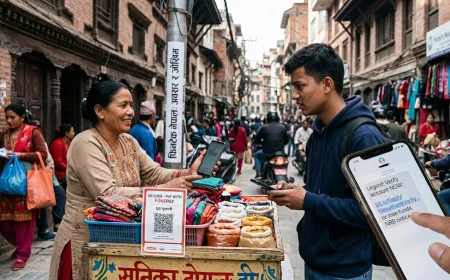
As financial networks expand, so do sophisticated methods of digital fraud. Scammers regularly prey on small vendors. Paru Ghimire shares that fraudsters copy her TikTok videos and comment under them using fake WhatsApp numbers, deceiving unsuspecting buyers into routing money away from the official shop.
In another sweeping trend, malicious pop-up links promising free streaming of major events like the FIFA World Cup have compromised countless bank accounts. For instance, Kathmandu resident Anil Dangol Maharjan clicked one such unverified link to download an app, only to discover his bank account completely wiped out shortly after.
According to the central bank's Strategic Analysis Report 2024, cyber fraud heavily intercepts youth dynamics: 1 out of every 2 cyber fraud suspects is between 19 and 24 years old, and 1 out of 3 is a student. Scammers heavily deploy fake parcel deliveries, social media manipulation, unverified e-commerce platforms, fake lotteries, and phishing attempts targeted at stealing One-Time Passwords (OTPs). A recent major server breach at a prominent capital market firm leaked the sensitive personal data (citizenship cards and phone numbers) of nearly 100,000 citizens onto the dark web.
The Way Forward: Security and Innovation
Addressing these security challenges requires a mix of robust system fires and deep-rooted public vigilance. IMS Software’s Tamrakar stresses that service providers are rarely compromised on a system level; instead, breaches happen because users accidentally bypass security loops. "No legitimate bank or payment gateway will ever ask for your password or OTP. Offers that sound too good to be true are always scams," he warns.
NRB Payment Head Nischal Bank echoes that while the regulatory body continues to enforce safety standards and conduct literacy drives, personal caution is the ultimate safeguard. "Fraud isn't unique to Nepal; it's a global issue. Every individual must operate digital banking under the assumption that they are targeted. Every attractive offer must be questioned."
For aspiring tech innovators, the NRB has established "Innovation Hubs" and "Regulatory Sandboxes" to test novel technologies. Experts conclude that if users master basic security practices, Fintech will continue to elevate Nepalese life and enterprise to historic heights.
What's Your Reaction?
 Like
0
Like
0
 Dislike
0
Dislike
0
 Love
0
Love
0
 Funny
0
Funny
0
 Angry
0
Angry
0
 Sad
0
Sad
0
 Wow
0
Wow
0