


























Supreme Court Clarifies
The Supreme Court of Nepal has ruled that expressing opinions on public interest issues under judicial consideration does not constitute contempt of court. The clarification came in a case related to a joint statement by four former Chief Justices on the dissolution of the House of Representatives.

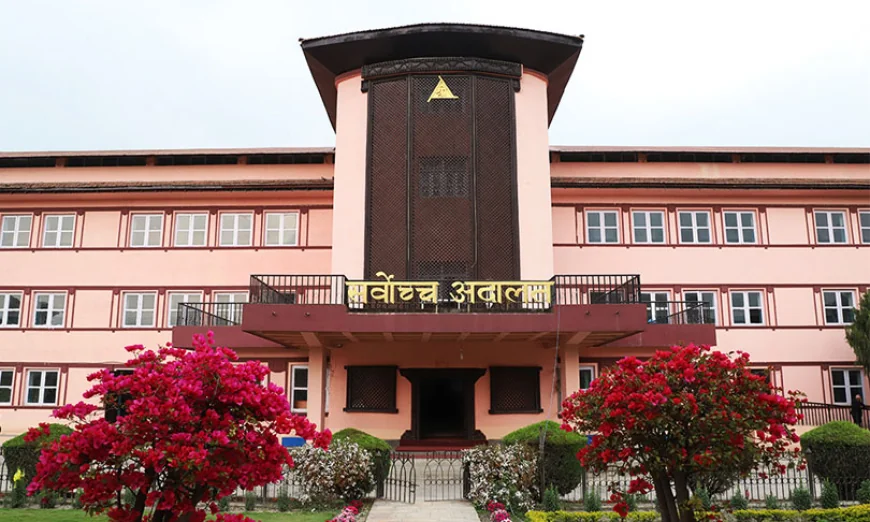


The Supreme Court of Nepal has clarified that expressing views on matters of public interest under judicial consideration does not amount to contempt of court. The ruling followed a contempt petition regarding a joint statement issued by four former Chief Justices concerning the dissolution of the House of Representatives.
The Court emphasized that freedom of thought and expression should not be narrowly interpreted to mean that no opinion can be expressed on a matter under judicial review. The full text of the judgment was published four years after the initial decision due to initial hesitancy by then Chief Justice Cholendra Shamsher Jabara.


The Court noted that citizens, the press, and public intellectuals are entitled to express their views on public interest issues and that such expression should not be prohibited. However, the Court warned that creating public pressure, influencing judicial decisions, or interfering with ongoing judicial processes could constitute contempt.
In the specific case, four former Chief Justices—Meen Bahadur Rayamajhi, Anup Raj Sharma, Kalyan Shrestha, and Sushila Karki—had issued a statement questioning the constitutionality and political implications of the House dissolution on December 20, 2020. The Supreme Court found that their statement did not comment on the judicial proceedings or attempt to influence the decision, and therefore, no contempt action was necessary.


The Court clarified that while citizens may express their opinions on national interest matters, such expressions must not mislead the public or unfairly pressure the judiciary. Any activity that undermines the integrity of the judicial process may still fall under contempt of court, but general public commentary on public interest matters should be considered part of a democratic and pluralistic society.
What's Your Reaction?
 Like
0
Like
0
 Dislike
0
Dislike
0
 Love
0
Love
0
 Funny
0
Funny
0
 Angry
0
Angry
0
 Sad
0
Sad
0
 Wow
0
Wow
0